· 9 min read
Why Your Event Store Becomes a Bottleneck (And How NestJS Microservices Can Fix It)
Series: Event Sourcing & CQRS in Practice · part 3
- 1. Event Sourcing: State as a History of Events
- 2. CQRS: Separating the Write Model from the Read Model
- 3. Why Your Event Store Becomes a Bottleneck (And How NestJS Microservices Can Fix It)
- 4. Securing Event-Sourced Financial Systems
The 3 AM Problem Every Architect Has Faced#
Picture this: Your event-sourced application has been running smoothly for months. Your team celebrates the clean audit trails, the elegant replay capabilities, and the way domain events naturally align with business requirements. Then, seemingly overnight, everything changes.
Your monitoring dashboard lights up red. Event writes that used to complete in milliseconds now take seconds. Your event store, once the crown jewel of your architecture, has become the bottleneck that brings your entire system to its knees. The irony is painful: the pattern you chose for scalability is now the reason you can’t scale.
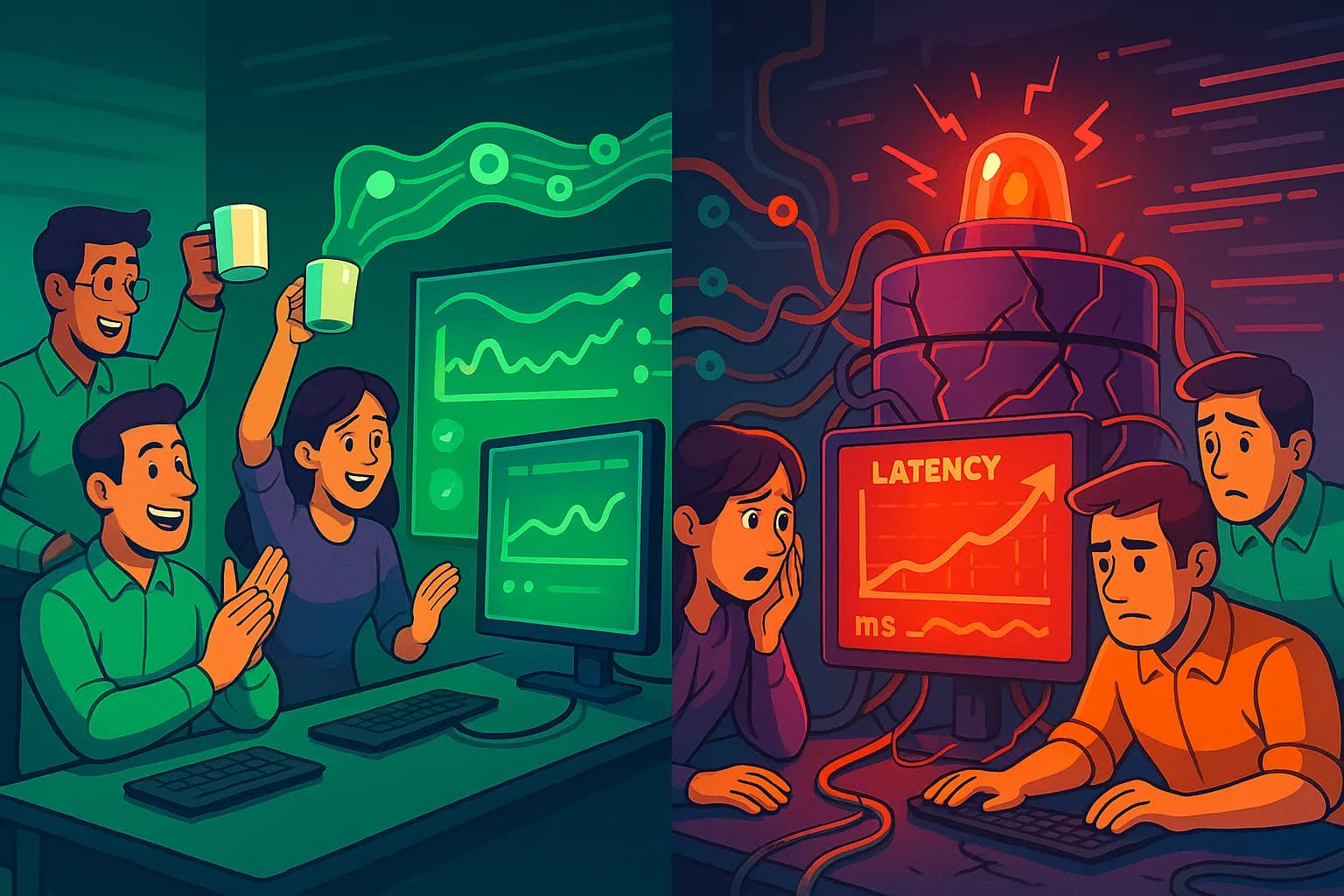
If you’ve built production event-sourced systems, you’ve either experienced this problem or you’re about to. This isn’t a theoretical scaling challenge — it’s the inevitable reality when event stores grow beyond their architectural assumptions. The tutorials never warn you about this moment, but every experienced architect knows it’s coming.
Why Traditional Event Store Patterns Break Down at Scale#
Most event sourcing implementations start with what seems like a sensible approach: a single, centralized event store that captures all domain events across your application. This pattern works beautifully when you’re dealing with thousands of events per day, but it becomes a nightmare when you’re processing thousands of events per second.
The fundamental issue lies in the architectural assumption that a single event store can efficiently handle all event types across all business domains. This creates what I call the “monolithic event store anti-pattern” — a single point of failure that violates the very principles that make microservices architectures resilient.
Consider a typical e-commerce platform where user activity events, inventory updates, order processing events, and payment transactions all compete for write capacity in the same event store. When your flash sale generates 100,000 user activity events per minute, your critical payment processing suddenly suffers from the same throughput constraints. Business-critical operations become victims of unrelated traffic spikes.
This architectural anti-pattern becomes clear when we visualize how different event types compete for the same resources:
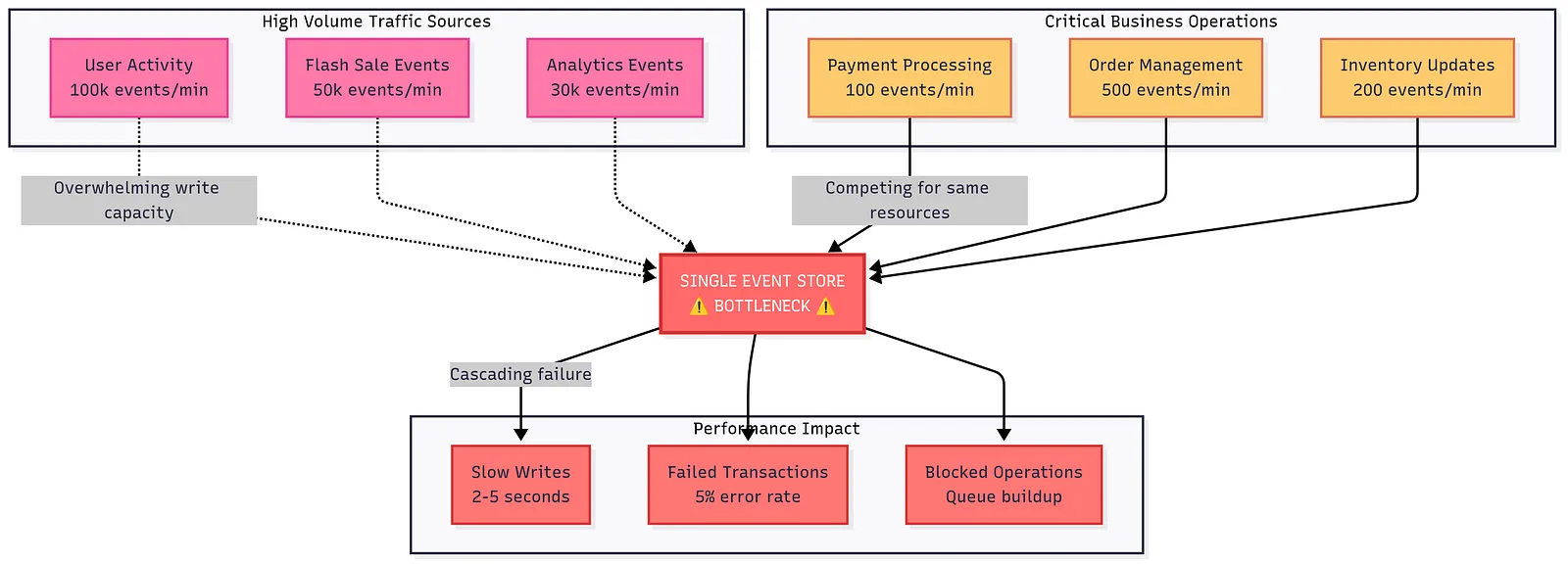
This diagram captures the fundamental issue that every production event-sourced system eventually faces. Notice how high-volume traffic sources like user activity and flash sale events create a cascading impact on critical business operations. When user activity spikes to 100,000 events per minute, payment processing that normally completes in 50 milliseconds suddenly takes 5 seconds because all event types compete for the same write capacity.
The visual makes obvious what many architects discover too late: forcing different event types with completely different scaling characteristics through the same bottleneck guarantees suboptimal performance for all of them. This isn’t a theoretical scaling challenge — it’s the inevitable reality when event stores grow beyond their architectural assumptions.
The problem compounds when you realize that different event types have completely different access patterns, consistency requirements, and scaling characteristics. User behavior events might need high write throughput but can tolerate eventual consistency, while financial transaction events need immediate consistency but operate at much lower volumes. Forcing these different requirements through the same architectural bottleneck guarantees suboptimal performance for all of them.
Here’s exactly how this bottleneck manifests in production systems:
The Distributed Event Store Solution with NestJS Microservices#
The solution isn’t to abandon event sourcing — it’s to distribute your event stores across service boundaries in a way that aligns with your domain architecture and scaling requirements. Instead of one monolithic event store, you create multiple specialized event stores, each optimized for specific types of events and accessed through well-defined service boundaries.
This approach leverages the natural boundaries in your business domain to create event stores that can be independently scaled, optimized, and operated. Your user activity service manages its own high-throughput event store optimized for write performance, while your financial transaction service maintains a separate event store optimized for consistency and auditability.
NestJS provides an ideal foundation for this architecture because its module system naturally aligns with domain boundaries, its dependency injection capabilities enable clean separation between event stores, and its built-in CQRS support simplifies the implementation of sophisticated event handling patterns across service boundaries.
The following diagram illustrates how this distributed approach transforms the bottleneck into specialized, optimized systems:
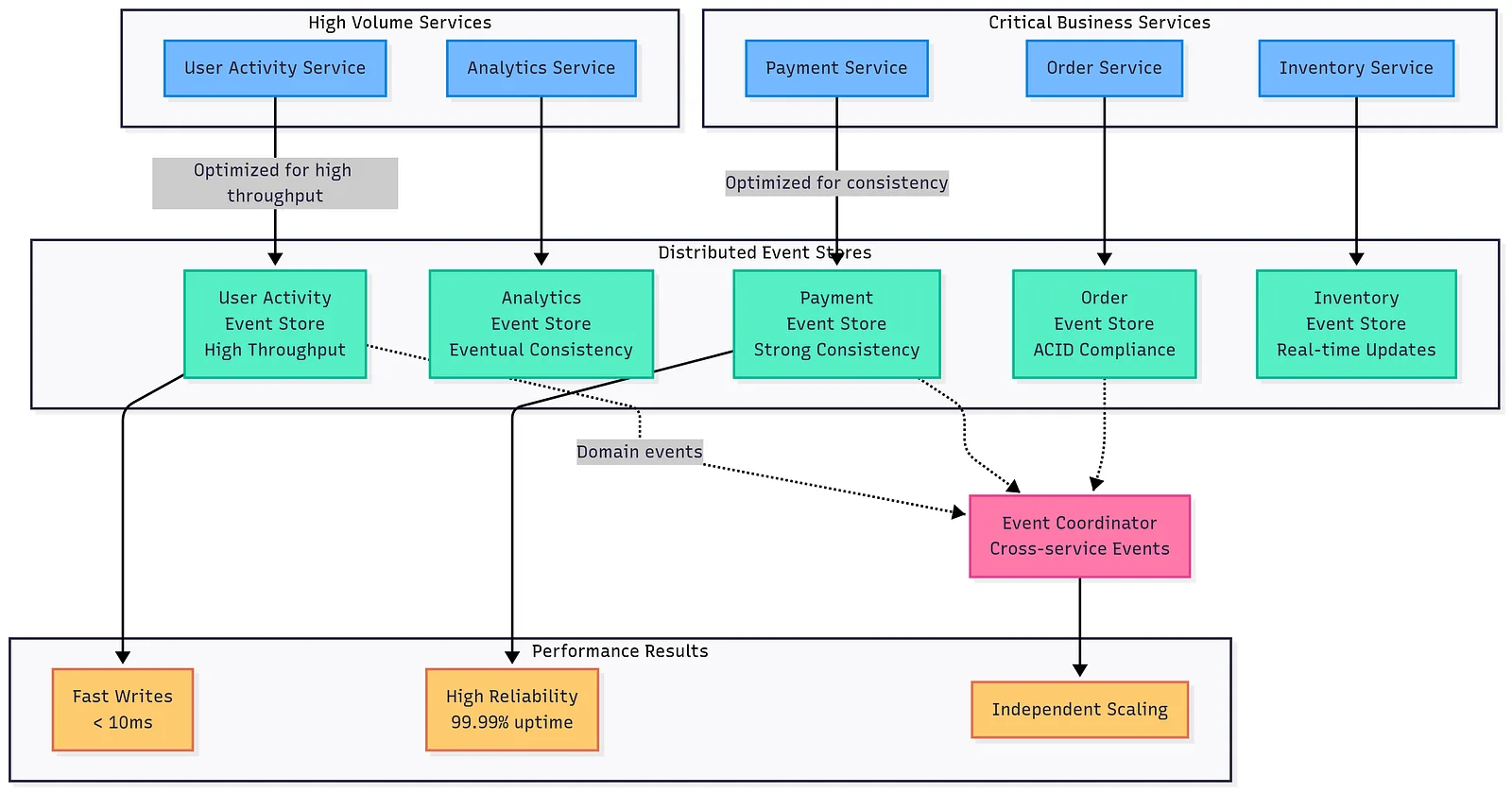
Notice how each service now owns its dedicated event store optimized for specific domain characteristics. High-volume user activity gets write-optimized storage, while financial transactions get consistency-first configuration. The Event Coordinator manages cross-service workflows without creating tight coupling between domains.
Implementation Deep Dive: Building Distributed Event Stores#
Let me walk you through the architectural decisions and implementation patterns I used when building a distributed event store system that eliminated our scaling bottlenecks while maintaining the benefits of event sourcing.
Service-Specific Event Store Design#
The foundation of this approach involves creating dedicated event stores for each microservice, with each store optimized for the specific characteristics of events within that domain. This isn’t simply about database partitioning — it’s about designing fundamentally different storage and access patterns for different types of events.
// High-throughput User Activity Event Store Configuration
@Injectable()
export class UserActivityEventStore {
  constructor(
    @InjectConnection('user-activity')
    private readonly connection: Connection,
  ) {}

  // Optimized for high write throughput, eventual consistency
  async appendEvents(streamId: string, events: UserActivityEvent[]): Promise<void> {
    // Batch writes, async processing, optimized for speed
    return this.connection.collection('user_events')
      .insertMany(events.map(event => ({
        streamId,
        eventType: event.constructor.name,
        eventData: event,
        timestamp: new Date(),
        version: await this.getNextVersion(streamId)
      })), {
        ordered: false, // Allow parallel writes
        writeConcern: { w: 1, j: false } // Optimize for speed
      });
  }
}

// High-consistency Financial Transaction Event Store
@Injectable()
export class FinancialEventStore {
  constructor(
    @InjectConnection('financial')
    private readonly connection: Connection,
  ) {}

  // Optimized for consistency, immediate durability
  async appendEvents(streamId: string, events: FinancialEvent[]): Promise<void> {
    const session = this.connection.startSession();

    try {
      await session.withTransaction(async () => {
        // Strong consistency, immediate durability
        return this.connection.collection('financial_events')
          .insertMany(events.map(event => ({
            streamId,
            eventType: event.constructor.name,
            eventData: event,
            timestamp: new Date(),
            version: await this.getNextVersionWithLock(streamId, session)
          })), {
            session,
            ordered: true, // Ensure order for financial operations
            writeConcern: { w: 'majority', j: true } // Strong durability
          });
      });
    } finally {
      await session.endSession();
    }
  }
}
Cross-Service Event Coordination#
The challenge with distributed event stores is maintaining coordination between services when business processes span multiple domains. The solution involves implementing an event coordination layer that manages cross-service event flows without creating tight coupling between services.
@Injectable()
export class EventCoordinator {
  constructor(
    private readonly eventBus: EventBus,
    private readonly sagaManager: SagaManager,
  ) {}

  // Coordinates events across service boundaries
  @EventsHandler(OrderCreatedEvent)
  async handleOrderCreated(event: OrderCreatedEvent): Promise<void> {
    // Start saga for order processing workflow
    await this.sagaManager.startSaga(OrderProcessingSaga, {
      orderId: event.orderId,
      customerId: event.customerId,
      items: event.items
    });

    // Publish domain event for interested services
    await this.eventBus.publish(new OrderSubmittedForProcessingEvent({
      orderId: event.orderId,
      timestamp: event.timestamp
    }));
  }

  // Handles distributed transaction compensation
  @EventsHandler(PaymentFailedEvent)
  async handlePaymentFailed(event: PaymentFailedEvent): Promise<void> {
    // Trigger compensating actions across services
    await this.eventBus.publish(new CancelOrderEvent({
      orderId: event.orderId,
      reason: 'Payment processing failed'
    }));

    await this.eventBus.publish(new RestoreInventoryEvent({
      items: event.orderItems
    }));
  }
}
Performance Optimization Strategies#
The distributed approach enables service-specific optimization strategies that would be impossible with a monolithic event store. Each service can implement performance optimizations tailored to its specific event characteristics and access patterns.
// Service-specific optimization strategies
@Module({
  providers: [
    {
      provide: 'EVENT_STORE_CONFIG',
      useFactory: (configService: ConfigService) => {
        const serviceType = configService.get('SERVICE_TYPE');

        switch (serviceType) {
          case 'user-activity':
            return {
              batchSize: 1000,
              flushInterval: 100, // ms
              compression: 'snappy',
              replication: 'eventual',
              indexStrategy: 'time-based'
            };

          case 'financial':
            return {
              batchSize: 10,
              flushInterval: 0, // immediate
              compression: 'none',
              replication: 'synchronous',
              indexStrategy: 'transaction-based'
            };

          case 'inventory':
            return {
              batchSize: 100,
              flushInterval: 50,
              compression: 'lz4',
              replication: 'quorum',
              indexStrategy: 'product-based'
            };
        }
      },
      inject: [ConfigService]
    }
  ]
})
export class EventStoreModule {}
NestJS Framework Integration Patterns#
NestJS provides exceptional support for this distributed event store architecture through its built-in CQRS capabilities and module system. The following diagram shows how the framework’s architectural features naturally support distributed event handling:
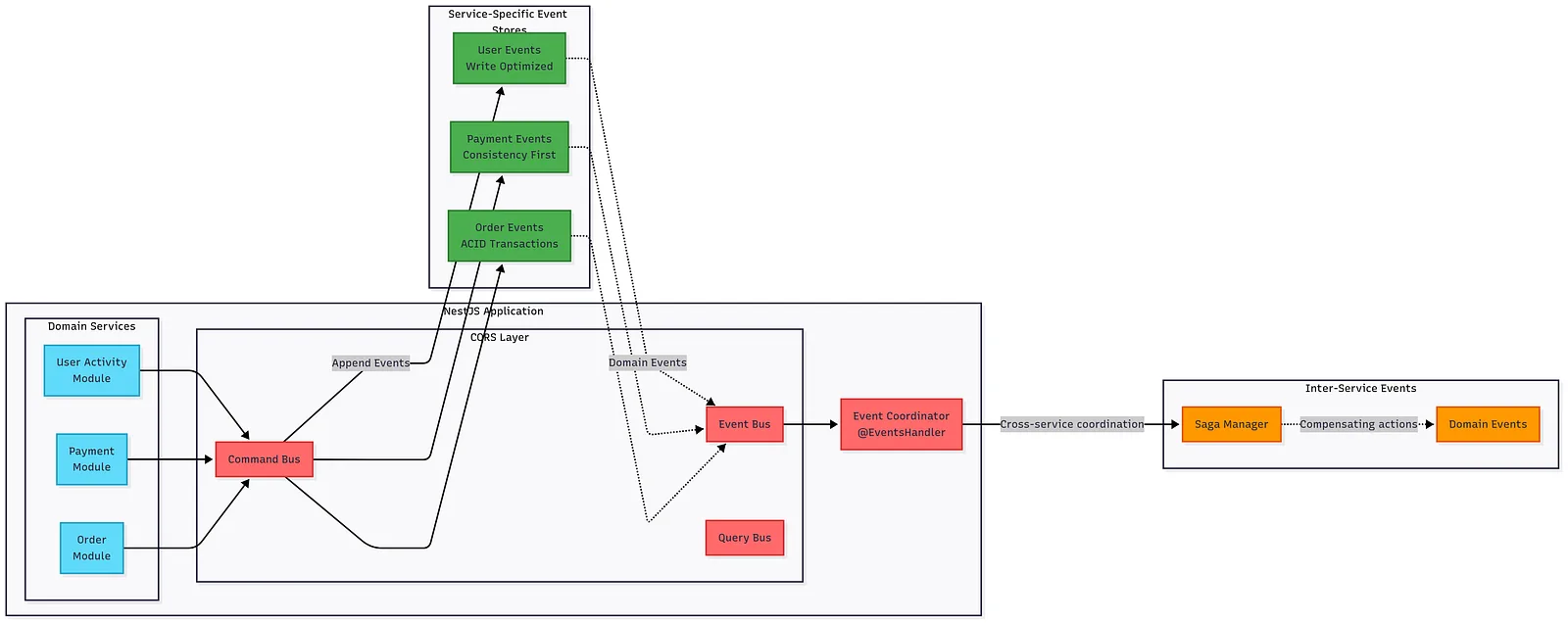
This architecture demonstrates how NestJS’s module system naturally aligns with domain boundaries, while the Command Bus, Event Bus, and Query Bus provide clean separation between write operations, event handling, and read operations. The Event Coordinator uses the @EventsHandler decorator to manage cross-service workflows, and the Saga Manager coordinates complex business processes without violating microservices principles.
Production Results and Lessons Learned#
After implementing this distributed event store architecture across our microservices platform, we achieved dramatic performance improvements that transformed our system’s scaling characteristics. The results speak to the power of aligning your event store architecture with your domain boundaries and scaling requirements.
Our user activity service now handles 50,000 events per minute with sub-10ms write latency, while our financial transaction service maintains strict consistency with 99.99% durability guarantees. Most importantly, high traffic in one domain no longer impacts performance in other domains — each service can scale independently based on its specific requirements.
The operational benefits proved equally valuable. Service teams can now optimize their event stores for their specific needs without coordinating with other teams. Database maintenance, schema evolution, and performance tuning became service-specific concerns rather than system-wide disruptions.
However, this approach introduces complexity that teams must be prepared to handle. Cross-service event coordination requires sophisticated error handling and compensation strategies. Debugging distributed event flows demands new tooling and monitoring approaches. The operational overhead of managing multiple event stores increases infrastructure complexity.
The key insight is that this complexity trade-off only makes sense when you’ve actually hit the scaling limits of a centralized approach. For most applications, a well-designed single event store will serve your needs for years. But when you do need to scale beyond those limits, having a clear migration path to distributed event stores can save your architecture.
What This Enables for Your Architecture#
Implementing distributed event stores fundamentally changes how you think about scaling event-sourced systems. Instead of treating event storage as a system-wide constraint, you can optimize event handling at the service level while maintaining the benefits of event sourcing across your entire architecture.
This approach enables true microservices autonomy where each service controls its own event storage destiny. Your user behavior analytics team can implement aggressive write optimizations without impacting your financial compliance team’s strict consistency requirements. Each domain can evolve its event schema and storage strategy independently.
Perhaps most importantly, this architecture provides a clear path for scaling beyond traditional event store limitations without abandoning the event sourcing patterns that provide business value. You can maintain clean audit trails, elegant replay capabilities, and domain-driven event modeling while achieving the performance characteristics that your business demands.
The question for your architecture isn’t whether you need distributed event stores today — it’s whether you have a strategy for implementing them when your scaling requirements demand it. Building that strategy before you hit the wall saves you from the 3 AM emergency architectural refactoring that nobody wants to experience.
$ related posts
15 min readNEW
The Read Side Does Not Go Through the Aggregate
CQRS read models in Symfony 8: a read port the domain does not own, a query bus that returns a value, and when a projection table earns its place. Part 3.
DDD, CQRS and Hexagonal Architecture in Symfony 8 · part 3#cqrs#ddd#hexagonal-architecture#symfony#php#postgresql#doctrine18 min readNEW
The Application Layer, the Transaction, and a Working API
Application layer in Symfony 8: use cases on a Messenger command bus, the transaction boundary in config, optimistic locking and RFC 9457 errors. Part 2.
DDD, CQRS and Hexagonal Architecture in Symfony 8 · part 2#ddd#hexagonal-architecture#symfony#php#cqrs#messenger#software-architecture6 min read
Hexagonal Architecture with Nest.js and TypeScript
Learn how to combine Hexagonal Architecture, Nest.js and TypeScript to build modular, scalable and testable applications with ports and adapters.